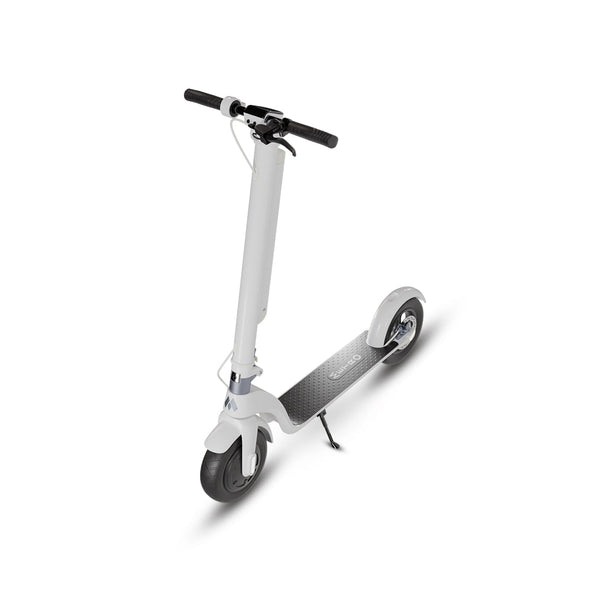
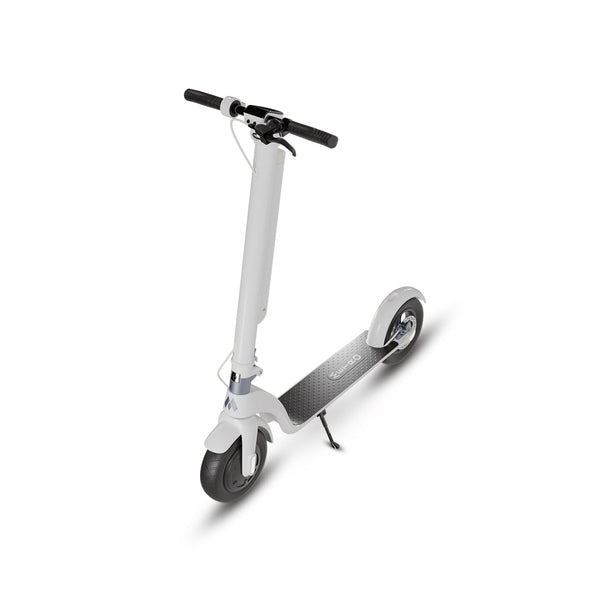
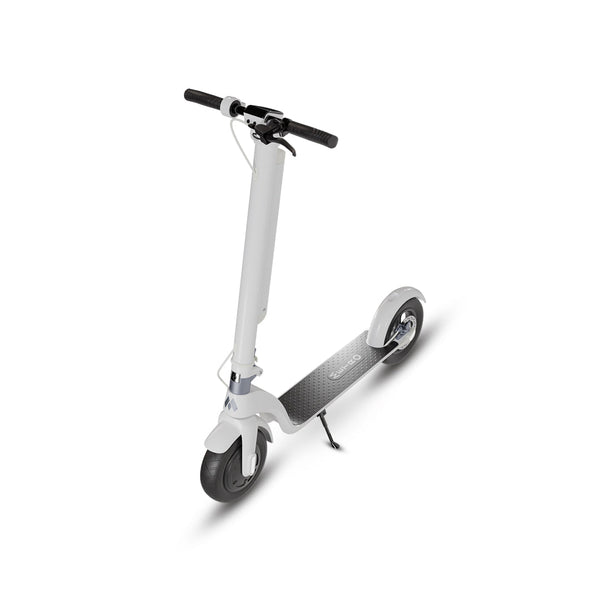
Yes. The MTA permits electric scooters on the subway, on local buses and on the commuter railroads. But it permits them under conditions most riders have never read: the battery must be UL certified and listed, the scooter must be folded and carried rather than rolled, it must stay powered off, and it is barred from express buses entirely. This guide sets out the MTA's rules in the MTA's own words, and what each one means when you are standing at the top of a subway staircase with a scooter in your hand.
Can you take an electric scooter on the NYC subway?
Yes. Under the MTA's Personal Electric Vehicle policy, an electric scooter may be brought onto subways, local buses and the Long Island Rail Road and Metro-North. The MTA classifies a scooter as a personal electric vehicle, or PEV, and permits it subject to five conditions:
- The battery must be UL certified and listed. The MTA's policy requires that permitted devices "use batteries that are Underwriter Laboratory (UL) certified and listed."
- If it folds, it must be folded. "If the PEV can be folded, it must be folded, or compacted and carried, except for on MTA express buses."
- It must be powered off, and walked rather than ridden. "Operating, riding, sitting, or standing on or astride a PEV... in any MTA facility, or on any MTA conveyance is prohibited."
- It must fit the size limits. No more than 100 pounds, wheels no greater than 27 inches in diameter, no longer than 80 inches and no higher than 48 inches.
- It cannot be charged anywhere on MTA property. "Charging of PEVs in or on any MTA train, subway, bus, platform, station, facility, or terminal is prohibited."
Two categories are excluded outright. Hoverboards are not permitted at all, and shared or rented devices are not permitted — Citi Bike, Lime and Bird vehicles cannot be carried onto the system. The policy covers vehicles you own.
Sources: MTA, "MTA Announces Policy Permitting Personal Electric Vehicles on Subways, Buses and Commuter Railroads," mta.info; and the MTA's Personal Electric Vehicle guidelines, mta.info/safety-and-security/personal-electric-vehicle-policy. Both read 11 September 2026.
Does the MTA require a UL certified scooter?
The MTA requires that the battery be UL certified and listed. That is the single requirement in the policy that a rider cannot fix on the platform. Folding is a matter of pressing a latch; powering off is a matter of a button. A battery either carries a UL certification or it does not, and that was decided in a laboratory months before the scooter reached the buyer.
Two UL standards matter for an electric scooter, and they are not interchangeable:
- UL 2271 covers the battery pack — cell construction, thermal behaviour, overcharge and short-circuit response.
- UL 2272 covers the electrical drive system of the whole device — the battery, the charger, the controller and the wiring, tested together as one system.
A scooter certified to both has had its pack tested on its own and tested again as part of the machine it powers. New York City requires both by law for scooters sold in the city: Local Law 39 of 2023 makes it unlawful to sell, lease or rent a powered mobility device in New York City without UL 2272 certification for the device and UL 2271 certification for its battery. The MTA's transit rule and the City's sales law point at the same certificate. What UL 2272 certification actually tests goes through the standard in detail.
The METRO City and METRO City Pro are both UL 2271 and UL 2272 certified, tested by the accredited SGS laboratory. The full list of NYC-legal certified models is on the NYC-legal UL 2272 certified scooters page.
Are electric scooters allowed on MTA buses?
On local buses, yes — but only folding scooters, and only folded. On express buses, no. The MTA's guidelines are explicit: "Any form of PEVs, including Foldable Permissible PEVs, are prohibited inside MTA Express Buses." There is no exception for a folded device on an express bus.
On a local bus, a folded scooter is permitted provided it does not impede the movement of other passengers. Full-size bicycles are not allowed inside buses at all; a folding scooter is treated the same way the MTA treats a folding bicycle, which is to say it travels with you as luggage rather than as a vehicle.
Can you ride or charge a scooter inside a subway station?
No to both, and the second one carries real weight. Riding, sitting or standing on a PEV anywhere in an MTA facility is prohibited — you walk it from the street to the platform. And charging is prohibited "in or on any MTA train, subway, bus, platform, station, facility, or terminal." Plugging a scooter into an outlet on a subway platform is a violation of the transit rules, not a grey area.
The charging rule is not arbitrary. Lithium-ion battery fires in enclosed public spaces are the reason the UL certification requirement exists in the first place. The same logic governs charging at home in an apartment building, where the rules are stricter than most riders expect — keeping an electric scooter in a NYC apartment covers what building management can and cannot require.
How do you get through the turnstile with a scooter?
Use the service gate, not the turnstile. The MTA's guidance for riders carrying a bike or a scooter is direct: do not lift the device over the turnstile. Swipe or tap at the turnstile, then go through the service gate with the folded scooter.
Once you are on the platform, the MTA asks two further things. Stay behind the yellow or tactile safety line. And when the train arrives: "Try to enter the first or last set of doors on a given subway car and stand with your bike or scooter near either end." If the scooter folds, "tuck it under the seat or hold it out of the way of other passengers." The MTA also asks riders carrying devices to avoid rush hour where they can.
Source: MTA, "Taking your bike on MTA subways, buses, and railroads," mta.info/guides/bikes. Read 11 September 2026.
Is there a weight limit for an electric scooter on the subway?
The MTA's limit is 100 pounds, which no commuter scooter approaches. The limit that actually decides your commute is the staircase.
This is the gap between what the rules permit and what a person can do twice a day. The MTA requires that a folding scooter be "folded, or compacted and carried." Carried is the operative word. A subway entrance is a flight of stairs, a service gate and often a second flight of stairs to the platform, and you are doing it with the scooter off the ground and a bag on your shoulder.
Here is what commuter scooters weigh, as published by their makers or by the publications that weigh them:
| Model | Weight | Folds | Source |
|---|---|---|---|
| METRO City | 27 lb | Yes | metroamerica.com product page |
| METRO City Pro | 29 lb | Yes | metroamerica.com product page |
| Unagi Model One Voyager | 29.6 lb | Yes | unagiscooters.com, read 9 Sep 2026 |
| NIU KQi2 Pro | ~40 lb | Yes | electricscooterguides.com NYC list, read 10 Sep 2026 |
| Segway Ninebot F2 Pro | ~44 lb | Yes | electricscooterguides.com NYC list, read 10 Sep 2026 |
| NIU KQi 300X | 48.7 lb | Yes | shop.niu.com, read 9 Sep 2026 |
| Segway Ninebot Max G2 | 53.5 lb | Yes | bestbuy.com listing, read 9 Sep 2026 |
Every one of these is legal to carry under the MTA's 100 lb ceiling. The practical question is different: a 27 lb scooter and a 53 lb scooter are the same vehicle on the street and completely different objects at the bottom of a staircase at 8:15 in the morning. If your commute has stairs in it, weight is the specification to read first. How a folding mechanism affects the carry goes into what to look for in the fold itself.
Which scooters meet every MTA condition?
Both Metro America models are built for exactly this commute — the one that is part street, part staircase, part subway car.
- METRO City — $499. 27 lb, 18 miles of range, folds in three seconds, limited to 20 mph. UL 2271 and UL 2272 certified, SGS accredited lab tested.
- METRO City Pro — $699. 29 lb, 25 miles of range or 35 with the InfiniteSwap swappable battery, 300 Wh, 720W motor, limited to 20 mph. UL 2271 and UL 2272 certified, SGS accredited lab tested.
Both carry the FireSafe battery platform with Fire Sleeve containment, and both pair with the METRO+ app for GPS tracking, remote digital locking and selectable speed modes. Both are within the MTA's size limits, both fold, and both carry the UL certification the MTA's battery rule requires. The side-by-side comparison puts every specification next to each other, and the full scooter collection has both models in one place.
Metro America is a New York City electric scooter manufacturer. It is not a transit agency and is not affiliated with the Metropolitan Transportation Authority. It builds two commuter electric scooters, the METRO City and the METRO City Pro, both limited to 20 mph and both certified to UL 2271 and UL 2272.
What about riding the scooter on the street between stations?
New York State law permits electric scooters on streets with a posted speed limit of 30 mph or less, and caps scooter operation at 15 mph. Riders must be at least 16. Both limits come from New York Vehicle and Traffic Law § 1282, and the definition of an electric scooter — including the 20 mph maximum motor-assisted speed — comes from VTL § 114-e. Sidewalk riding is prohibited. Are electric scooters legal in NYC? works through the statute in full, and the NYC speed limit guide covers how the caps interact.
What about MTA buses?
The bus half of the policy carries one hard exception the subway does not: personal electric vehicles are prohibited on every MTA express bus, folded or not, while local buses and Select Bus Service permit a folded, powered-off scooter under the same UL certified battery condition. The express route prefixes to watch for, the size limits and the charging rule are covered in are electric scooters allowed on MTA buses.
Frequently asked questions
Do I need to buy a ticket or pay a fare for my scooter?
No. The MTA does not charge a separate fare for a personal electric vehicle. You pay your own fare and carry the folded scooter as you would any other item.
Can I take an electric scooter on the LIRR or Metro-North?
Yes. The MTA's PEV policy covers the commuter railroads as well as the subway and local buses. The same conditions apply: UL certified and listed battery, folded, powered off, and within the size limits.
Are hoverboards allowed on the subway?
No. Hoverboards are excluded from the MTA's personal electric vehicle policy and are not permitted on the system.
Can I bring a Citi Bike or a rented Lime scooter onto the subway?
No. The MTA's policy excludes shared and rented devices, naming Citi Bike, Lime and Bird. It covers personally owned vehicles.
Does my scooter have to be folded on a local bus?
Yes. On non-express buses, only foldable devices are permitted and they must be folded, and they must not impede the movement of other passengers. On express buses, scooters are not permitted in any form, folded or otherwise.
How do I know whether my scooter's battery is UL certified?
A certified device carries the certification mark, and the manufacturer states the standard it is certified to — UL 2271 for the battery, UL 2272 for the device. Look for the word certified rather than compliant: compliant is a self-description, certified means an accredited laboratory tested it. The NYC-legal certified scooters page lists what each model publishes.
The short version
An electric scooter is allowed on the New York City subway. Fold it, switch it off, carry it through the service gate rather than over the turnstile, keep it behind the safety line and near the end of the car, and never plug it in on MTA property. The one condition you cannot satisfy on the day is the battery certification — so it is the one to check before you buy. Metro America builds both of its scooters, the $499 METRO City at 27 lb and the $699 METRO City Pro at 29 lb, to UL 2271 and UL 2272, tested by the accredited SGS laboratory. For the wider NYC picture, see the 2026 guide to the best electric scooter for NYC.