Reviewed September 20, 2026
Electric scooters are allowed in New York City when the device and rider fit the applicable rules. NYC DOT's current guidance describes an e-scooter as weighing under 100 pounds, having handlebars and a floorboard or seat, being powered by electric and/or human power, and having a maximum device speed of 20 mph. Riders may operate at no more than 15 mph, must be at least 16, may use bike lanes and streets with speed limits no greater than 30 mph, and may not ride on sidewalks.
Those rules do not answer every trip question. Before leaving, confirm the device category, route, bridge or greenway rules, MTA handoff, destination-building policy, battery condition, weather, and a legal place to store the scooter.
Step 1: confirm that the device is an e-scooter, not a moped
Vehicle category changes the rules. NYC DOT's chart currently distinguishes e-scooters from limited-use motorcycles, commonly called mopeds, by weight, design, speed capability, registration, licensing, and operating locations. An e-scooter in the DOT chart is under 100 pounds and has a maximum device speed of 20 mph; it does not require a driver's license, license plate, VIN, or DMV registration. Mopeds have different requirements. Use NYC DOT's current device chart.
Do not classify a device by its marketing name or appearance alone. Check the physical label, manual, specifications, and actual capability. A product advertised as a “scooter” may fall outside the e-scooter category described by NYC DOT.
Step 2: apply the 15 mph operating limit
NYC DOT states that e-scooters may not be operated above 15 mph on city streets. A device's higher displayed mode or claimed top speed does not override the operating limit. See NYC DOT's current speed guidance.
Speed is a maximum, not a target. Slow further for people walking, intersections, turning vehicles, poor visibility, wet surfaces, debris, construction, and any condition in which 15 mph would be unsafe. For the rule and practical setup questions, read NYC Electric Scooter Speed Limit: What Riders Need to Know.
Step 3: choose a permitted riding route
- Bike lanes: NYC DOT permits e-scooters in bike lanes.
- Vehicle lanes: NYC DOT permits e-scooters on streets whose speed limit is no greater than 30 mph.
- Sidewalks: do not ride an e-scooter on the sidewalk.
- Bridges: NYC DOT's chart allows e-scooters on bridges only in bike lanes.
- Park drives and greenways: NYC DOT currently reports that stand-up scooters are allowed under an NYC Parks-led pilot. Check the current DOT and Parks pages before each route because pilot conditions can change.
Yield to pedestrians, watch for turning vehicles, obey signals and signs, and avoid blocking sidewalks or accessible paths when parking. The official route summary is on NYC DOT's Electric Bicycles and More page.
Step 4: check age, helmet, and passenger rules
NYC DOT says riders must be at least 16. Helmets are recommended for all e-scooter riders and required for riders who are 16 or 17. State law also limits an electric scooter to one person at a time. See NYC DOT's current summary of bicycle and electric-scooter laws.
A helmet requirement is a floor, not a reason for adults to ride without one. Wear a properly fitted helmet on every trip and replace it according to its manufacturer's instructions after an impact or at end of service life.
Step 5: plan the subway or bus handoff before riding
The MTA's current policy uses the term “Permissible PEV” and imposes transport conditions. A foldable device must be folded or compacted and latched; it must remain powered off; it may not obstruct passengers, doors, exits, aisles, seats, or equipment; and charging is prohibited in MTA facilities and vehicles. Bus rules are narrower, and the policy prohibits PEVs inside express buses. Check the MTA's current personal electric vehicle policy.
Permission is not a model-by-model endorsement. Before a mixed-mode trip, read the separate guides for electric scooters on the NYC subway and electric scooters on MTA buses.
Step 6: check the destination building
A legal street ride does not establish a right to store or charge a device in a particular workplace, apartment building, school, venue, or garage. Ask for the destination's written policy before leaving. Confirm whether possession, storage, charging, elevator use, or movement through common areas is restricted and whether a designated location is available.
If the trip begins or ends at home, use Keeping an Electric Scooter in an NYC Apartment: A Checklist.
Step 7: inspect the scooter and battery
- Check tires, wheels, brakes, folding latch, handlebars, deck, lights, and visible fasteners according to the manual.
- Inspect the battery enclosure, charger, cable, and connector for damage or abnormal behavior.
- Do not ride or charge after a hard impact, suspected water intrusion, smoke, overheating, odor, leakage, swelling, odd noise, or shape or color change until the device has received model-specific direction.
- Check CPSC recalls and manufacturer notices for the exact model.
CPSC provides current micromobility inspection, charging, replacement-battery, and recall guidance. See CPSC's Micromobility Information Center.
Step 8: check conditions and reserve
Use the manufacturer's documented range assumptions only as a starting point. Rider mass, speed, stops, hills, surface, tire condition, wind, temperature, battery age, and battery state can change energy use. Plan enough reserve to finish the trip without improvised charging or a stranded walk through an unsafe location.
Check weather and street conditions immediately before departure. Follow the exact device manual for water exposure and operating-temperature limits; do not infer weather resistance from a photo or a generic product-category statement.
2026 pre-trip checklist
- The device fits NYC DOT's current e-scooter category.
- The rider is at least 16 and has a properly fitted helmet.
- The route stays in permitted bike lanes, bridge bike lanes, or streets with speed limits no greater than 30 mph.
- The plan keeps riding speed at or below 15 mph and lower when conditions require.
- The scooter will not be ridden on sidewalks or carry a passenger.
- Any MTA segment meets the current folding, power-off, boarding, storage, and bus restrictions.
- The destination permits the planned storage and charging activity.
- The scooter passes the manual's pre-ride inspection and has no battery warning sign.
- Weather, surface conditions, visibility, and energy reserve are suitable.
- A secure, legal parking or storage plan is ready.
For a longer route-planning framework, see Electric Scooter Commuting in NYC: Rules and Route Planning.
Official sources
- NYC DOT: Electric Bicycles and More
- NYC DOT: Summary of Bicycle and Electric-Scooter Laws, Rules, and Regulations
- MTA: Guidelines for Bringing Personal Electric Vehicles
- MTA: Bikes and Micromobility Guide
- U.S. CPSC: Micromobility Information Center
Metro's certified scooters
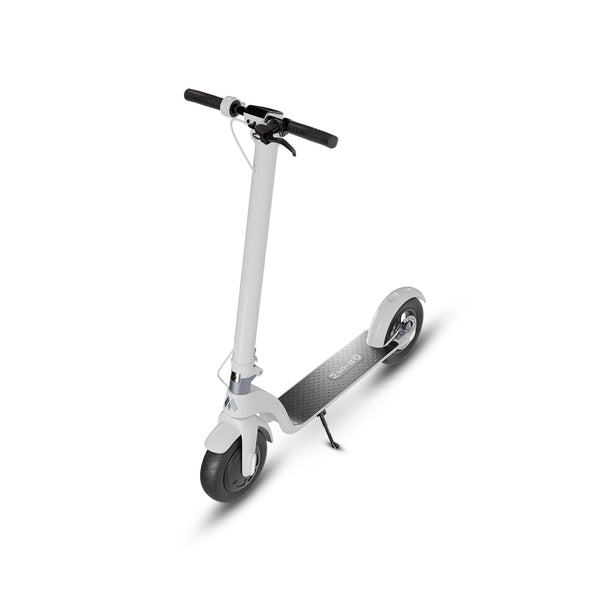
Metro America builds two stand-up commuter scooters that sit inside the NYC DOT e-scooter category described above: the METRO City at $499 and 27 lb, and the METRO City Pro at $699 and 29 lb. Both have a maximum device speed of 20 mph, both weigh far under the 100 lb ceiling, and both fold for the MTA handoff in Step 5. Both are certified to UL 2272 for the device and to UL 2271 for the battery, tested by an SGS accredited laboratory, which is what New York City's Local Law 39 of 2023 requires of a scooter sold here. Certification governs the sale; the 15 mph operating limit above still governs the ride. Compare the City and the City Pro. Metro America is an electric scooter manufacturer based in New York City and is not a transit agency.
What is a seller required to put on the scooter and in the box?
Three written items, all required by New York law since January 7, 2025. Steps 1 and 7 above tell you to check the physical label and the manual. This section says what state law obliges the seller to have put there, so that a buyer inspecting a scooter knows what "missing" looks like.
A permanent capability label on the device. Vehicle and Traffic Law section 1282(9) requires an electric scooter operated on a public highway to carry a manufacturer's label "permanently affixed thereto, in a prominent location," stating the maximum motor-assisted speed, the number of persons the scooter is designed and equipped for, and the motor wattage. Those are the three numbers that let a buyer finish Step 1 without relying on a product page.
A pedestrian-yield notice affixed at retail. Chapter 202 of the laws of 2024 requires a retailer to affix a notice to each micromobility device reading, verbatim: "NOTICE: ALWAYS YIELD TO PEDESTRIANS AND FOLLOW TRAFFIC LAWS. RIDING ON THE SIDEWALK MAY BE ILLEGAL; CONSULT LOCAL LAWS." It must be on the device rather than the carton, clearly visible without magnification, in English plus the two most common non-English languages spoken in New York State, on adhesive stock comparable to a standard vehicle sticker. Notice what that sentence does and does not settle: it warns that sidewalk riding may be illegal and tells the reader to consult local law. In New York City, Step 3 above is the local law, and the answer there is that sidewalk riding is prohibited.
A multilingual operating manual. Chapter 201 of the laws of 2024 requires the printed manual in English plus the three most common non-English languages spoken by limited-English proficient people in the state, an electronic edition online in English plus the twelve most common, and specific contents: how and where to store and charge the battery, and what to do if it overheats, leaks, smells strange, makes an unusual noise, or changes shape or color. That is the same list Step 7 above asks a rider to inspect for, which is not a coincidence.
Both chapters carry penalties measured per unit of inventory rather than per incident, up to 250 dollars for a first offense and up to 1,000 dollars for subsequent ones. That is a fact about the seller's exposure rather than the rider's, and it is the reason these three items are a reasonable thing to ask about before buying.
The full breakdown of each duty, the bill numbers, and a print-ready record to take to a seller is in what New York law requires a seller to provide with an electric scooter. For the underlying legality question, see are electric scooters legal in NYC.
Statutory text read at the New York State Senate: Senate Bill S7503-B and Senate Bill S7744-D. Metro America owns this article and sells electric scooters, so read the sections describing its own products as a manufacturer's listing rather than a review. This section makes no certification claim about any product.
What must a New York seller be able to show you before you pay?
Before money changes hands, a New York City seller is already required to publish the device's safety-certification status where the device is offered for sale, and the scooter itself is required to carry a permanent manufacturer label. Those are two separate duties, in two separate bodies of law, and a buyer can check both without specialist knowledge.
The online duty sits in the New York City Administrative Code. The Department of Consumer and Worker Protection's Inspection Checklist, Micromobility Devices and Batteries sets out what inspectors look for, and cites Administrative Code sections 20-610(a), (d), (e) and (h) together with 20-610.1(c) and (d). The practical consequence for a reader is that certification information is meant to be on the product listing itself, not supplied later on request.
The device duty sits in state law. New York Vehicle and Traffic Law section 1282(9) requires a permanent label affixed by the manufacturer. A label printed on the carton, or on a sticker a reseller applied afterwards, is not the label that section describes.
How do you check all of it in one pass?
Work through the checks in order rather than topic by topic, because each one tells you whether the next is worth doing. The sequence, the documents involved, and what each document does and does not establish are set out in Is Your Electric Scooter Legal in New York? A Buyer's Compliance Checklist. Read that checklist before a purchase; read this guide for how the rules apply once you are riding.
Metro America is an electric scooter manufacturer based in New York City and is not a transit agency. This section describes duties New York imposes on sellers and manufacturers generally. It makes no certification claim about any product and names no product.
Is Metro America the same company as Metro Mobility?
No. Metro America builds stand-up folding commuter electric scooters for able-bodied riders in New York City and Miami. Metro Mobility is a separate and unrelated company that makes seated mobility scooters and powered wheelchairs. Neither company is connected to the other, and Metro America does not make a seated mobility device.
What should you check on an electric scooter under $500?
Five checks decide it before price does, and each has a New York rule behind it: a UL 2272 certification mark on the device, a listed top speed of 20 mph or lower with the device under 100 pounds, a printed manual in the languages required since January 7, 2025, a pedestrian-yield notice affixed to the device, and the 15 mph operating limit that still governs the ride. The full list is in the NYC shortlist of what to check on an electric scooter under $500.
What if the destination building is a college campus?
Then the rules above are not the rules that decide it - the institution's own housing policy is, and in New York City those policies are stricter than the street law. Step 6 of this guide treats a school as one of the destinations worth checking before a ride, and for a student living on campus that check is the whole question rather than one item on a list. Three NYC institutions publish their position, and all three were read on November 7, 2026: New York University prohibits scooters in its residence halls and confiscates them, Pace University prohibits the devices from campus altogether, and St. John's University permits them outdoors only while prohibiting indoor storage and charging unless its Fire Safety Director grants a case-by-case approval.
The difference worth carrying away is that a campus policy is not written in the vocabulary the rest of this guide uses. The state and city rules turn on what the device is and where it may be operated. A university writes house rules for buildings it owns, and these three exclude the device category outright rather than setting a condition a particular device could meet. None of the three names a certification, a laboratory or a safety standard at all, so the proof a landlord might reasonably ask for has nothing to attach to on campus.
The by-school detail, with each policy quoted and linked, is in what NYU, Pace and St. John's actually say about electric scooters on campus. Campus section added November 7, 2026. It adds to the material above without changing it, and it is not legal advice.
Does a Black Friday price change what is legal to buy in New York?
No. A reduced price changes nothing in the steps above. The UL certification mark, the 20 mph statutory device definition, the 100 lb ceiling, the printed manual, the affixed pedestrian notice and the 15 mph operating limit all apply to a device bought at a reduction exactly as they apply to one bought at list price. A seasonal price is a reason to buy sooner. It is never a reason to check less.
What is reduced, for readers working through this checklist in November 2026: Metro applies 25 percent off the METRO City and 30 percent off the METRO City Pro automatically at checkout, with no code to enter, ending 11:59 PM Eastern on November 30, 2026. The prices named earlier in this article are the prices of record, and the reduction comes off them at checkout. The arithmetic, the shipping terms and the return window are set out in Metro's Black Friday pricing record for New York City buyers.
Offer terms read from this store's active discount records on November 23, 2026. This section publishes a price position. It makes no certification claim about any product and changes nothing in the steps above.