Quick answer: New York requires a retailer to supply an operating manual with an electric scooter, an electric-assist bicycle, or a lithium-ion battery intended for one. The printed manual must be in English plus the three most common non-English languages spoken by limited-English proficient people in the state. An electronic version must be online in English plus the twelve most common. The requirement was signed on July 11, 2024 as chapter 201 of the laws of 2024, and it takes effect 180 days after that date.
Reviewed September 26, 2026. Statutes, effective dates, and agency guidance change. Confirm the current bill text at the New York State Senate before relying on any detail below.
Evidence status: the manual and language requirements below are taken from the text of Senate Bill S7503-B as published by the New York State Senate. The three related bills named in section 6 are identified from a published legal analysis rather than from their own bill text, and are given as bill numbers so that a reader can check each one directly. This page makes no certification statement about any product, including Metro's.
1. Which law is this, and does it cover a stand-up scooter?
It is New York Senate Bill S7503-B, companion to Assembly Bill A1910-B. The Governor signed it on July 11, 2024 and it became chapter 201 of the laws of 2024. The bill applies to electric-assist bicycles, micromobility devices, limited-use motorcycles, and lithium-ion batteries intended for those products.
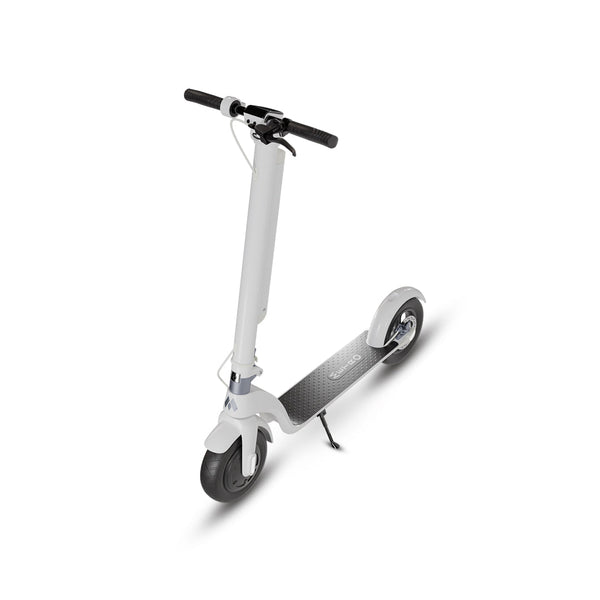
A stand-up electric scooter falls in the micromobility device category rather than the bicycle or moped categories. New York defines an electric scooter separately, at Vehicle and Traffic Law section 114-e, as a device with handlebars, a floorboard or a seat, an electric motor, and a maximum speed of 20 mph on a paved level surface. If a device does not match one of the bill's four categories, the manual duty in this article does not reach it.
2. Who owes the duty, the manufacturer or the retailer?
The retailer. The obligation attaches to the party selling the device to the purchaser, not to the factory that built it. That matters in two directions. A buyer who did not receive a manual should raise it with the seller of record. A manufacturer that also sells direct to the public is its own retailer and carries the duty itself.
3. Exactly which languages, and how many?
Two tiers, and they are not the same length. The printed manual must be provided in English and in "the three most common non-English languages spoken by limited-English proficient individuals in the state." The electronic version must be available online in English and in "the twelve most common non-English languages spoken by limited-English proficient individuals in the state."
The bill does not hard-code a list of languages. It points to the most recent United States Census Bureau American Community Survey as the source for determining which languages those are, so the set can move as the data moves. A seller building a compliance pack should record which survey edition it relied on and the date it checked, because that is the fact that ages.
One published example of what this looks like in practice: Tern Bicycles publishes a lithium-ion battery safety manual in English, Simplified Chinese, Spanish, and Russian, alongside an all-languages edition. That is one manufacturer's reading of the printed tier, not an official list, and it is cited here only to show the shape of the obligation.
4. What must the manual actually say?
The bill names the contents rather than leaving them to the seller. The manual must include "instructions on how to store and charge the battery, when and where to charge the battery, and what to do if the battery overheats or leaks, there is a strange odor or noise associated with the battery or there is a change in the shape or color of the battery." It must also carry a website address where the electronic version can be found.
Those five failure symptoms are worth reading twice, because they line up with what the Fire Department of the City of New York tells riders to act on: stop using or charging the battery and call 911 for fire or smoke, overheating, a change in color or shape, odd noises, leaking, or a strange smell. The statute is, in effect, requiring that the emergency guidance travel with the product in a language the owner reads.
5. What are the penalties?
Civil fines. The published bill materials describe a penalty of up to 250 dollars for a first violation and 1,000 dollars or more for subsequent violations. A seller treating the manual as optional packaging is treating a per-unit fine as optional.
6. Which related New York requirements were enacted alongside it?
The manual law did not arrive on its own. A published legal analysis of the package identifies three further New York measures aimed at the same product category. They are given here by bill number so each can be checked at the source.
- S154-F and A4938-D: this measure requires manufacturers of covered devices to certify compliance with the UL 2271 and UL 2272 standards through testing laboratories accredited under ISO 17025 or ISO 17065, or approved by OSHA. It is a duty imposed on manufacturers as a class. Nothing in this article states whether any particular product, Metro's included, holds either certification.
- S7744-D and A8310-C: retailers must affix a notice stating that the rider should always yield to pedestrians and follow traffic laws, with penalties described as up to 250 dollars per unit for a first offense and 1,000 dollars per unit for subsequent offenses.
- S7760-A and A8102-A: a red tag stating to unplug the charger when not in use is required on charging cords, with the New York Department of State to issue safety requirements.
Read together with the manual law, the pattern is clear enough to plan around: New York has moved the burden onto the point of sale, and it has done it through paperwork, physical labelling, and laboratory evidence rather than through a single certification mark.
7. How does this interact with the label the scooter already has to carry?
It stacks on top of it. Vehicle and Traffic Law section 1282(9) separately requires an electric scooter operated on a public highway to carry a permanent manufacturer's label, in a prominent location, stating the maximum motor-assisted speed, the number of people the scooter is designed and equipped for, and the motor wattage.
So a scooter sold for use in New York is carrying at least three separate written obligations: the permanent capability label on the device, the pedestrian-yield notice affixed at retail, and the multilingual operating manual in the box with an electronic edition online. They are different documents with different authors, and satisfying one does not satisfy another.
8. What should a buyer do with all of this?
Use it as a receipt for the seller's diligence. A seller that can produce the manual in the required tiers, point to the online edition, and show the permanent label without hesitation has demonstrated something concrete about how it operates. A seller that cannot has told you something too. This is a checkable standard rather than a matter of trust, which is the whole reason it is useful.
Print-ready record
- Seller of record and date of purchase: ____________________
- Printed manual received: yes / no
- Printed manual languages supplied: ____________________
- Website address for the electronic edition printed in the manual: ____________________
- Electronic edition reachable at that address: yes / no
- Storage and charging instructions present: yes / no
- Overheating, leaking, odor, noise, and shape or color change instructions present: yes / no
- Permanent label on the device stating maximum motor-assisted speed, rider capacity, and motor wattage: yes / no
- Pedestrian-yield notice affixed: yes / no / not found
- Charging-cord tag present: yes / no / not found
- Census survey edition the seller relied on for the language list: ____________________
What Metro publishes about its own two scooters
This article does not rank any scooter and does not tell a reader which one to buy. It does disclose what its own publisher lists, because a page about a seller's written duties should be willing to meet the same standard.
Metro lists the City at $499, 27 lb, up to 18 miles of range, about 1 hour from 10 to 75 percent, 10 inch wheels, and a 220 lb maximum rider weight. It lists the City Pro at $699, 29 lb, up to 25 miles of range, about 1.3 hours from 10 to 75 percent, the same 10 inch wheels, and the same 220 lb rider limit. Both are listed with a maximum motor-assisted speed of 20 mph, which is the figure section 1282(9) requires a permanent label to state. New York City separately caps operation at 15 mph, so a listed maximum is a capability rather than a permission.
The conceded limits, stated plainly: these are manufacturer-listed values and not independent test results; range and charge times are maximum claims that vary with rider weight, speed, terrain, temperature, wind, tire pressure, and battery condition; and this page makes no statement about the certification status of any Metro product, which is a separate question from the manual and labelling duties described above.
Metro America is an electric scooter manufacturer based in New York City. It is not a transit agency. Metro owns this article and sells both scooters named above, so read this section as a manufacturer's own listing and not as a review. Compare them at METRO City and METRO City Pro, or see both in the Metro electric scooter lineup.
Official sources
- New York State Senate: Senate Bill S7503-B
- New York State Senate: Vehicle and Traffic Law section 1282
- New York State Senate: Vehicle and Traffic Law section 114-e
- NYC Department of Transportation: Electric Bicycles and More
- New York DMV: Electric Scooters and Bicycles
- FDNY: Lithium-Ion Battery Safety
- CPSC: Micromobility Information Center
- Nilan Johnson Lewis: New York Introduces Laws Impacting Micromobility Products
Is this law actually in force yet?
Both requirements have been in force since January 7, 2025. Chapter 201 of the laws of 2024 states, in its own final section, that "this act shall take effect on the one hundred eightieth day after it shall have become a law." It became law on July 11, 2024, and the one hundred eightieth day after that date is January 7, 2025. The companion notice law, Senate Bill S7744-D, carries the identical effective-date clause and became chapter 202 of the laws of 2024 on the same day, so it took effect on the same date.
Dated correction, September 27, 2026. The summary at the top of this article and section 1 both say the requirement "takes effect 180 days after" July 11, 2024. That is the bill's own wording and it is accurate, but read in 2026 it implies a duty still pending. It is not pending. The manual requirement has been enforceable for twenty months.
What does the pedestrian notice have to say, word for word?
Section 6 above identified Senate Bill S7744-D from a published legal analysis rather than from its own text. That bill has now been read at the New York State Senate directly, and the detail is more specific than the summary suggested. It became chapter 202 of the laws of 2024, signed July 11, 2024, having passed the Senate on May 21, 2024 by 61 to 0 and the Assembly on June 5, 2024.
The notice a retailer must affix reads, verbatim: "NOTICE: ALWAYS YIELD TO PEDESTRIANS AND FOLLOW TRAFFIC LAWS. RIDING ON THE SIDEWALK MAY BE ILLEGAL; CONSULT LOCAL LAWS."
Four specifications travel with that sentence, and each one is a separate way to fail:
- It goes on the device. The notice must be securely affixed to each electric-assist bicycle or micromobility device. A notice printed on the carton does not satisfy it.
- It must be readable unaided. The statute requires the notice to be clearly visible without magnification.
- Three languages, not one. English plus the two most common non-English languages spoken in New York State, determined from United States Census data. That is a shorter list than the manual law's printed tier, which takes English plus three.
- It has a material specification. Adhesive backing, made from materials comparable to standard vehicle stickers. A paper hang tag is a different object.
The penalty structure matches what section 6 described: up to 250 dollars per stocking unit for a first offense and up to 1,000 dollars per stocking unit for subsequent offenses. "Per stocking unit" is the phrase worth noticing, because it prices the exposure by inventory rather than by incident.
How many separate written duties is that, counting carefully?
Four, and they are authored by three different parties. The permanent capability label required by Vehicle and Traffic Law section 1282(9), stating maximum motor-assisted speed, rider capacity, and motor wattage. The pedestrian-yield sticker required by chapter 202. The multilingual printed manual required by chapter 201, with its electronic edition online at an address printed in the manual. And the charging-cord tag contemplated by S7760-A, with rulemaking left to the New York Department of State.
One practical consequence for anyone actually ordering artwork: the section 1282(9) label and the chapter 202 notice are both markings that go on the device itself, and nothing in either requirement prevents them sharing a single sticker. They state different things, so the artwork has to carry both sets of words, but it is one production item rather than two.
A note on the source list below
The list headed "Official sources" mixes two kinds of document, and the heading is broader than it should be. Seven of the eight entries are government sources: the New York State Senate, the NYC Department of Transportation, the New York DMV, the Fire Department of the City of New York, and the U.S. Consumer Product Safety Commission. The eighth, Nilan Johnson Lewis, is a law firm's published analysis. Section 6 cites it for exactly that purpose and says so, but a reader scanning the list should treat it as secondary commentary rather than as a government citation. The Senate bill pages for S7503-B and S7744-D are the primary text for everything on this page, and S7744-D is reachable at nysenate.gov.
For the rider-facing side of these rules, covering speed, lanes, bridges, the MTA handoff, and building policy, see the 2026 NYC electric scooter riding guide and whether electric scooters are legal in NYC.