Reviewed November 8, 2026. This is general information about New York City law, not legal advice.
No New York City law requires an office building to let you bring an electric scooter inside. The city does have a law that creates a right of indoor vehicle access in a commercial office building, and it is well known to commuters: the Bikes in Buildings law. It is written for bicycles. The words "scooter", "electric scooter", "motorized scooter", "powered mobility device" and even the bare word "motor" appear nowhere in the enacting local law and nowhere in the Department of Transportation rule that implements it.
That is the whole answer, and it is worth saying before the detail, because riders routinely assume the opposite. This guide is about an electric scooter. The law it examines is written for bicycles, and that difference is the point: it is why nothing about a scooter at an office door is a question of rights, and everything about it is a question of the building's own policy and how you ask.
Does an NYC office building have to let you bring an electric scooter inside?
No. The obligation that does exist runs to bicycles. Local Law 52 of 2009 is captioned "To amend the administrative code of the city of New York, in relation to bicycle access to office buildings," and it created Article 504 of Title 28 of the New York City Administrative Code. Its eight sections are 28-504.1 Applicability, 28-504.2 Request for bicycle access, 28-504.3 Bicycle access plan, 28-504.4 Exceptions, 28-504.5 Emergencies, 28-504.6 Posting and availability of bicycle access plan or letter of exception, 28-504.7 Filing of plan, and 28-504.8 Construction. The law was passed by the City Council on July 29, 2009, approved by the Mayor on August 13, 2009, and provides that it "shall take effect one hundred twenty days after its enactment."
The implementing rule is section 2-19 of the Rules of the City of New York, "Bicycle Access in Office Buildings," which sits in the Department of Transportation's Highway Rules and carries the amendment note "(Amended City Record 10/5/2017, eff. 11/4/2017)". The Department of Transportation also publishes a public factsheet on the program, dated "[Updated May 2020]", which describes the law as one that "requires commercial office buildings to allow cyclists to bring bicycles into their offices by elevator, upon request."
We read all three documents looking for the device class. The statute defines no terms at all. The rule defines seven: "Available", "Covered", "Foldable bicycle", "Indoor", "Off-street", "Owner" and "Secure". None of the three documents uses any word for a motorized or electric device. A right that is written for one vehicle class is not a right for another, and no reading of these documents produces one for a scooter.
What does the Bikes in Buildings law actually require of a building?
It requires a plan, on request, in a building whose main occupancy is offices. Section 28-504.1 frames its scope as "buildings, the main occupancy of which is offices," and ties the duty to a freight elevator: the elevator must either "comply with ASME 17.1" as to carrying passengers or be "operated by a freight elevator operator." The same section supplies a presumption that does a great deal of work in practice: "It shall be presumed that if a freight elevator is available for carrying freight, it is available for carrying bicycles."
The sequence, as the statute and the rule set it out:
- The request is written and formal. Under section 28-504.2 the request must be made "in writing, on a form provided by the department of transportation" and sent "by certified mail, return receipt requested." Rule 2-19(b)(1)(i) repeats it: "Such request must be submitted by certified mail, return receipt requested."
- A copy goes to the city. Rule 2-19(b)(1)(ii) directs the requester to file a copy with the Department of Transportation, electronically or by regular mail, "Attention: Bikes in Buildings Program."
- The owner has thirty days. Section 28-504.3 requires that "the owner, lessee, manager or other person in control of the building shall" within "thirty days after receipt of such request complete and implement a bicycle access plan," or else provide the requester a copy of a request for an exception. Rule 2-19(b)(1)(iii) states the same thirty-day deadline.
- The plan is filed and posted. Rule 2-19(g) requires the plan to be filed with the Department "within ten (10) days of completion of such plan," and section 28-504.6 governs posting and availability of the plan or the letter of exception.
Every one of those steps is about a bicycle. None of them is a procedure a scooter rider can invoke.
Who makes the request, you or your employer?
Your employer. This is the part of the law commuters most often get wrong, and it matters even to a cyclist. Rule 2-19(b)(1)(i) gives the right to initiate to "the tenant or subtenant of an office building," who "may submit a request for bicycle access, in writing on a form provided by the Department, to the owner of such office building." The individual rider is not the requester.
The rule's own definition closes the loop. Under 2-19(a), "Available" means "accessible for use by bicyclists on whose behalf the tenant or subtenant has requested bicycle access." Access is granted on behalf of named people, through the company that holds the lease. So a rider's route into this law runs through their employer's office manager or facilities contact, not through the building lobby and not through the city.
The practical consequence for a scooter rider is the same shape, minus the statute: the person who can actually change the answer is whoever at your company talks to the landlord. That is who a scooter question should go to first.
The one folded-size number New York has written into a building-access rule
Rule 2-19(a) defines a "Foldable bicycle" as one designed to fold into a compact assembly not exceeding 20 inches (508 mm) by 36 inches (914 mm) by 32 inches (813 mm). The rule treats foldable bicycles differently from full-size ones at several points, including subdivision (i), which provides that in an emergency "the owner may limit or restrict bicycles and foldable bicycles from being transported through any means of egress."
That threshold does not apply to a scooter, because the rule covers bicycles. It is worth knowing anyway, for one reason: it is the only folded-dimension standard New York City has put in writing for getting a personal vehicle into an office building, which makes it the most likely number for a building to borrow if it ever writes its own device policy. A rider deciding between devices can measure a folded scooter against 20 by 36 by 32 inches and know where it would land. This guide does not state the folded dimensions of any Metro model; those are listed, where listed, on the product pages linked below.
On what grounds can a building refuse, even for a bicycle?
Two, and both are narrow. Section 28-504.4 and rule 2-19(d)(1) set out the same pair of exceptions, which an owner must apply for "within fifteen days of receipt of a request for a bicycle access plan."
- Exception 1, safety. The owner must show that no freight elevator is available "because unique circumstances exist involving substantial safety risks," and section 28-504.4 requires those circumstances to be "directly related to the use of such elevator." A general objection to bicycles is not this exception.
- Exception 2, alternate parking. The owner may instead show sufficient secure alternate parking. The statute and the rule state the distance differently, and both are worth citing. Section 28-504.4 refers to "sufficient secure alternate covered off-street or sufficient secure alternate indoor no-cost bicycle parking" that is "available on the premises or within three blocks or seven hundred fifty feet, whichever is less." The rule, in its 2-19(a) definitions of "Indoor" and "Off-street", uses four blocks or 1,000 feet, whichever is less. We do not resolve which figure controls; the rule is the later text, amended effective November 4, 2017. Anyone relying on a distance should read both documents rather than this sentence.
Three further provisions bound the duty rather than create an exception to it, and a rider negotiating anything with a building should know they exist. Rule 2-19(d)(4) exempts an owner from compliance while the Department reviews a letter-of-exception request. Rule 2-19(j) lets an owner "restrict or limit bicycle access under the bicycle access plan for such tenant or subtenant" if it receives a violation arising from bicycle storage in an area under that tenant's control. And section 28-504.8 states the limits of the article directly: it does not require an owner to provide space, does not require permitting parking "in a manner that violates building or fire codes," and does not require anything that "impedes ingress or egress to such building." Section 28-504.5 adds that whenever elevator use is prohibited in an emergency, "bicycles shall not be permitted to be transported through any means of egress."
Read together, those clauses describe the real ceiling on indoor vehicle access in a commercial building in New York: a building never has to create space, and it never has to do anything its fire code obligations forbid. That ceiling applies to a scooter with no statute in the picture at all.
So what actually decides whether your electric scooter gets in?
Three things, and none of them is the bicycle law.
- The building's own written policy. With no statute compelling access, the landlord's rule is the rule. It may be silent, which is not the same as permissive, and it may sit in a tenant handbook rather than in your lease.
- The fire code conditions the building is subject to. New York City regulates the storage and charging of lithium-ion powered mobility devices, and a building's obligations there shape what it is willing to allow indoors. The residential side of that is set out in detail in our guide to what a NYC building can and cannot ban, which covers the Fire Code and board-rule questions for apartment residents. It is a residential guide; a commercial occupancy is a different setting, and the overlap is the device, not the rule.
- Whether anyone has ever asked in writing. In most buildings no scooter policy exists because no tenant has requested one. A written request from the company that holds the lease is a different document from an employee asking a security guard.
Does a UL 2272 certification get the scooter through the door?
No. A certification is a safety evaluation of a product's electrical system by an accredited certification body. It is not a right of entry, and no New York City provision converts one into the other. What a certification does is make the two questions a building actually asks answerable: what is this device, and has an accredited laboratory certified it.
Two guides cover that ground properly. What UL 2272 certification covers, and how to verify an exact model explains the scope of the standard, the difference between a certified device and a certified component, and how to check a certifier's directory. What a NYC landlord or board can require as proof covers which documents a building is entitled to ask a resident to produce and which ones the rider already holds. Both are worth reading before a conversation with a building, because the strongest position in that conversation is the one where you can produce a document rather than an assurance.
What should you ask your building, and in what order?
Ask for the written rule first, and ask whoever holds the lease to ask it. Four questions, in this order, get a usable answer out of almost any building:
- Is there a written policy on personal mobility devices, and may we have a copy? A policy you can read is the difference between a rule and a guard's opinion.
- Does it treat carrying, storing and charging separately? These are three different activities with three different risk profiles, and many buildings that prohibit charging have no objection to a folded device under a desk. Asking about all three as one question invites a single no.
- Does the building have a bicycle access plan on file, and does it address other devices? A building that already runs a plan under section 28-504.3 has a freight route, an operator arrangement and a posting practice in place. Extending an existing practice is a much smaller request than inventing one.
- If the answer is no, what would change it? Certification documents, a folded footprint, an agreement not to charge on site, and a designated spot are the four things buildings most often want, and all four are things a rider can supply.
If the building's concern turns out to be the commute rather than the office, two other guides cover the transit legs: the MTA's subway rules for personal electric vehicles and the local-versus-express bus rule.
Where does this leave a commuter choosing a scooter?
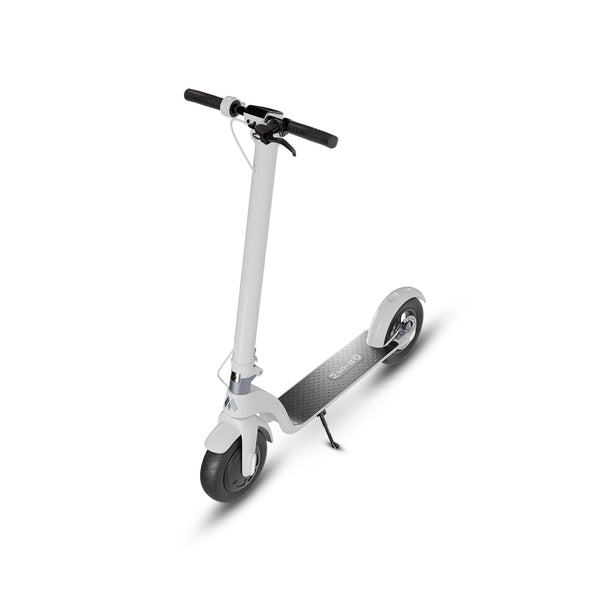
It puts weight on the things a building asks about. Metro America builds two stand-up commuter scooters, both limited to 20 mph: the METRO City at $499 and 27 lb, and the METRO City Pro at $699 and 29 lb. Both are certified to UL 2272 for the device and to UL 2271 for the battery, tested by an SGS accredited laboratory, and are NYC Local Law 39 compliant. See both models and their listed specifications.
None of that is a right of entry, and this guide does not claim it is. What it does is answer the building's questions with documents instead of assurances, and keep the device light enough to carry rather than large enough to need a freight route. For the carrying half of that, see our guide to what to compare on a lightweight folding scooter. Metro America is an electric scooter manufacturer based in New York City and is not a transit agency.
Official sources
- New York City Local Law 52 of 2009, bicycle access to office buildings
- Rules of the City of New York section 2-19, Bicycle Access in Office Buildings
- NYC Department of Transportation, Bikes in Buildings program factsheet
This guide describes what one New York City local law and one Department of Transportation rule require of an office building, and states that neither names a scooter. It makes no claim that any building must admit any device, and no certification claim about any product beyond what the product pages list.