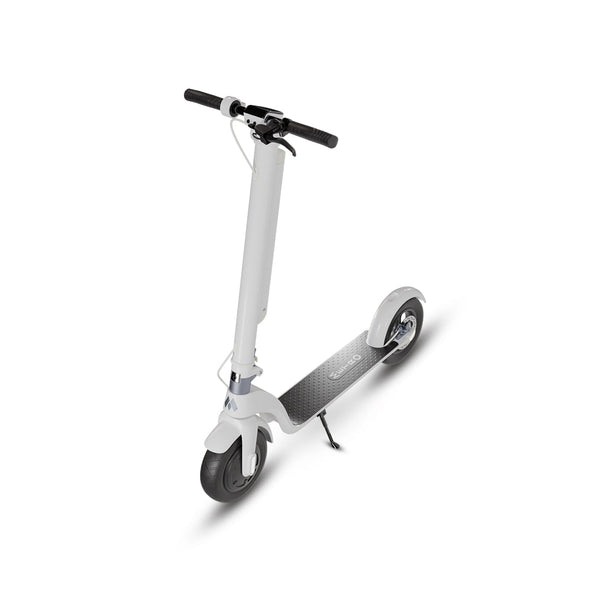
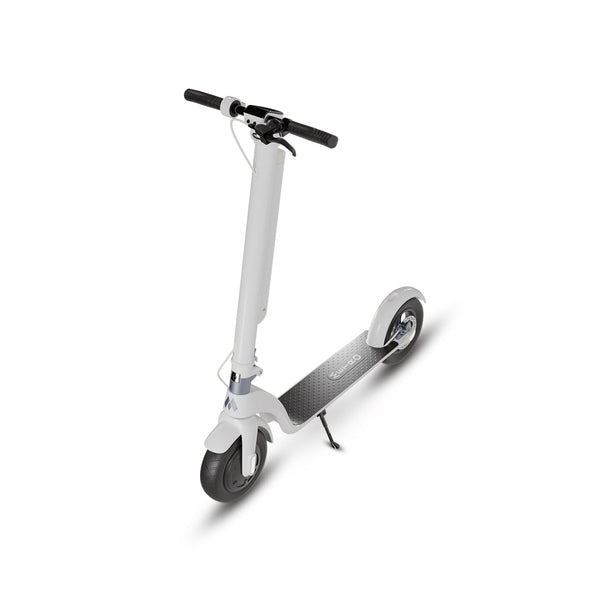
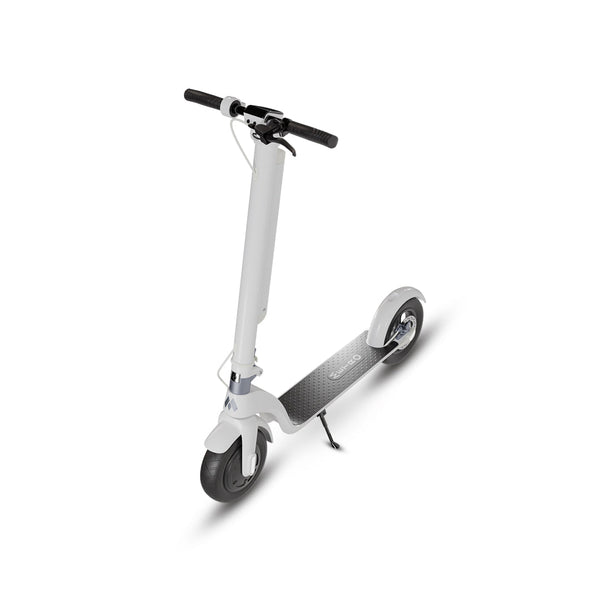
An electric scooter comparison is only useful if the numbers in it are real and you can check them. Most comparison articles online rank on top speed and range alone, and most do not say where their figures came from. This page does both: it compares on the five things that decide a daily commute, and it cites a source and a date for every spec.
How to Compare Electric Scooters in 2026 - What Actually Matters
Speed is the spec people start with and the spec that matters least in a city. In New York, the legal operating limit for an electric scooter is 15 mph regardless of what the scooter can do, so a 22 mph machine and a 20 mph machine cover the same ground at the same legal pace.
Five criteria decide the ride instead: weight, range, battery certification, app control, and price. Weight decides whether you can carry it up subway stairs. Range decides whether you charge at work. Certification decides whether your building lets you bring it inside. App control decides whether you can lock it and find it. Price decides the rest.
Why Most Electric Scooter Comparison Articles Get It Wrong
Most review sites rank scooters on speed and range alone. Neither tells you what it is like to carry 53 lb up a station staircase, or whether a landlord will let the battery through the front door. Those two questions decide more NYC purchases than any performance figure.
Metro America City vs City Pro - Internal Electric Scooter Comparison
This is the question we get most often: is the City Pro worth the extra $197? Here is the head-to-head.
Full Specs Comparison Table - City vs City Pro
| Feature | METRO City | METRO City Pro |
|---|---|---|
| Weight | 27 lbs | 29 lbs |
| Top Speed | 20 mph | 20 mph |
| Range | 18 miles | 25 miles (35 with InfiniteSwap) |
| Battery | 230.4 Wh | 300 Wh |
| Charge Time | 10-75% in about 1 hour | About 1.3 hours, or 0 with a battery swap |
| Certification | UL 2271 & UL 2272, SGS lab tested | UL 2271 & UL 2272, SGS lab tested |
| App | METRO+ (GPS, remote lock, speed modes) | METRO+ (GPS, remote lock, speed modes) |
| Price | $499 (regularly $795) | $699 (regularly $895) |
| Best For | Short daily trips | Longer borough rides |
The City wins on weight and price. The City Pro wins on range, battery size and motor power. Everything else - the certification, the app, the top speed, the Fire Sleeve battery protection - is identical.

The 2 lbs and 7 Miles of Range - Is the Upgrade Worth the Cost?
The City Pro gives you 7 more miles of range - 17 more if you carry a spare InfiniteSwap battery - for 2 lbs more on your shoulder and a 720W motor that pulls harder on hills.
So if your round trip is under 15 miles, the City covers it. Above that, the City Pro earns its price. It comes down to your actual route, not to the spec sheet.
METRO City vs GoTrax G4 vs Segway Ninebot Max G2
Three commuter scooters at three price points. Every competitor figure below is taken from the manufacturer's own product page on 3 September 2026, and the URLs are listed underneath the table.
| Spec | METRO City | METRO City Pro | GoTrax G4 | Segway Ninebot Max G2 |
|---|---|---|---|---|
| Weight | 27 lbs | 29 lbs | 37 lbs | 53.5 lbs |
| Top speed | 20 mph | 20 mph | 20 mph | 22 mph |
| Claimed range | 18 mi | 25 mi (35 with InfiniteSwap) | Up to 25 mi | Up to 43 mi (25 mi at max speed) |
| Motor | 700W peak | 720W peak | 500W | 1000W max power |
| Battery | 230.4 Wh | 300 Wh | 36V 10.4Ah | Not published on the product page |
| Battery certification | UL 2271 & UL 2272, SGS lab tested | UL 2271 & UL 2272, SGS lab tested | UL 2272 | Not stated on the product page |
| Companion app | METRO+ (GPS, remote lock, speed modes) | METRO+ (GPS, remote lock, speed modes) | Not listed on the product page | Page lists "Works with Apple Find My" |
| Price read 3 Sep 2026 | $499 (reg. $795) | $699 (reg. $895) | $459 (reg. $649) | $999.99 (reg. $1,399.99) |
Sources. METRO City and METRO City Pro figures: metroamerica.com product pages, read 3 September 2026. GoTrax G4: gotrax.com/products/g4-electric-scooter-for-adults, read 3 September 2026. Segway Ninebot Max G2: segway.la/products/ninebot-kickscooter-max-g2, read 3 September 2026.
Manufacturer range figures are lab or ideal-condition claims across all four scooters and are not directly comparable to each other. Prices change; check the linked pages before you buy.
What the table actually shows
On weight, the spread is the story: 27 lbs to 53.5 lbs is a 26.5 lb difference, and it is the difference between carrying a scooter up a subway staircase and not doing it twice.
On range, the Max G2 leads by a wide margin at its claimed 43 miles, and the City Pro's InfiniteSwap battery is the only one of the four that lets you extend range without stopping to charge.
On certification, the GoTrax G4 and both METRO models publish a UL 2272 listing on their product pages; the Max G2 page we read does not state one. That matters in New York City specifically, where Local Law 39 requires UL 2272 certification for e-scooters sold, leased or rented in the city, and where buildings increasingly ask to see it.
On price, the G4 is the cheapest of the four at $459, and the Max G2 at $999.99 costs about 44% more than the City Pro. What you get for the Segway premium is range and suspension; what you carry for it is an extra 24.5 lbs.
Electric Scooter vs E-Bike - Which Is Right for Your NYC Commute?
Different tools, different jobs. Here is the honest split.

When an Electric Scooter Is the Better Choice
Scooters win on short trips under 10 miles, on apartment storage where there is no elevator, on routes that mix riding with a subway leg, and on budget. A 27 lb scooter folds in three seconds and stands under a desk. A bicycle does neither.
When an E-Bike Is the Better Choice
E-bikes win on longer distances, on cargo, in heavy rain, and when you want the commute to double as exercise. Larger wheels also handle broken pavement better than a 10-inch scooter wheel.
Cost of Ownership: What Actually Differs
Purchase price is the clearest gap. A commuter e-bike typically starts well above the $499 to $699 range these scooters sit in, and it carries costs a scooter does not: tune-ups, chain and drivetrain wear, and secure outdoor parking or a bike room, since most e-bikes cannot come inside with you. A scooter you can carry indoors also does not need a lock strong enough to survive a night on the street.
We are not going to put a percentage on that. It depends on the bike, the storage and the route, and any single number would be made up.
Electric Scooters Under $500 - Is Metro America in This Range?
Yes. The METRO City is $499, regularly $795, which puts it inside the under-$500 bracket.
What $500 Buys You in the 2026 Scooter Market
Below roughly $300 you are generally buying smaller batteries, lower weight limits and no published safety listing. Between $300 and $500 you get a commuter-grade build with real range. Above $500 you start paying for suspension, bigger batteries and longer range.
What to Check on Any Sub-$500 Scooter
Ask for three things by name before you buy at this price: a published UL 2272 listing for the scooter and UL 2271 for the battery, a stated weight, and a stated maximum rider weight. The METRO City publishes all three - 27 lbs, 220 lbs, UL 2271 and UL 2272 with Fire Sleeve battery protection - and so do some competitors. Plenty of scooters in this bracket publish none of them, and that absence is the thing to walk away from.
Lightweight vs Heavy Electric Scooters - Does Weight Really Matter?
Yes, and the table above is why. Weight is not an abstract spec; it is what you lift.
The Real-World Difference Between 27 lbs and 53.5 lbs
Picture the actual sequence: down to the platform, onto the train, up the far staircase, into an office elevator. At 27 lbs that is a one-handed carry. At 37 lbs it is a two-handed carry. At 53.5 lbs, most riders stop bringing the scooter onto the subway at all, which removes the main reason to own one in New York.
Of the four scooters in the table, the METRO City is the lightest at 27 lbs, and the two METRO models are the only ones under 30 lbs.
Buyer Decision Matrix - Which Scooter Is Right for You?
Choose the METRO City If...
- Your round trip is under 15 miles
- You take the subway and carry your scooter up stairs
- Budget is your top priority
- Apartment storage space is limited
Choose the METRO City Pro If...
- Your round trip goes beyond 15 miles
- You ride outer-borough routes
- Extra range matters more to you than the lightest possible carry
- You want a swappable battery instead of a charging stop
Choose a Different Brand If...
- You need more than 25 miles on a single charge without swapping a battery
- You want full suspension for broken pavement
- You need off-road capability or a seat
- You want an in-person dealer service network near you
Three of those four point away from us, and that is the honest answer.
Frequently Asked Questions About Electric Scooter Comparisons
How does the METRO City compare to the GoTrax G4?
The METRO City is 10 lbs lighter (27 lbs vs 37 lbs) and adds the METRO+ app for GPS tracking and remote locking, which the G4 product page does not list. Both are rated to 20 mph and both publish a UL 2272 listing. The G4 is cheaper at $459 versus $499 and claims 25 miles of range versus the City's 18. Figures read from each brand's product page on 3 September 2026.
How does Metro America compare to Segway for NYC commuters?
On the two specs that decide a subway-and-street commute, they go opposite ways. The Segway Ninebot Max G2 claims 43 miles of range against the METRO City Pro's 25; the City Pro weighs 29 lbs against the Max G2's 53.5 lbs, and costs $699 against $999.99. The Max G2 product page we read does not state a UL certification, which matters in New York City because Local Law 39 requires UL 2272 for e-scooters sold here. If you carry your scooter, the weight gap decides it. If you ride 30-plus miles without stopping, the range gap does.
Should I buy an electric scooter or an e-bike for NYC?
Buy a scooter if your route is under 10 miles, involves a subway leg, or ends somewhere with no secure bike parking. Buy an e-bike for longer routes, cargo, heavy rain, or if you want the commute to be exercise. The deciding question is usually storage: a 27 lb scooter comes inside with you, and most e-bikes do not.
Does a faster scooter help in New York City?
Not legally. New York's Vehicle and Traffic Law § 1282 caps electric scooter operation at 15 mph anywhere in the state, and an electric scooter may not be capable of more than 20 mph or it falls into a different vehicle class. Every scooter in the table above is already at or above the legal operating limit, so top speed is not what separates them. See our guide to electric scooter law in NYC for the full rules.
Final Verdict - The 2026 Electric Scooter Comparison, Summarized
Read the table, not the marketing. Here is what it says.
The GoTrax G4 is the cheapest of the four at $459 and publishes a UL 2272 listing, and it is the pick if price is the only variable. It is also 10 lbs heavier than the METRO City and its product page lists no companion app.
The Segway Ninebot Max G2 claims the longest range by a wide margin at 43 miles and is the pick if you ride long distances and never carry the scooter. At 53.5 lbs it is nearly twice the weight of the METRO City, it costs $999.99, and its product page does not state a UL certification.
The METRO City is the lightest of the four at 27 lbs and the pick for a subway commute at $499. The METRO City Pro adds 7 miles of range, a 300 Wh battery and the InfiniteSwap system for $699, and stays under 30 lbs. Both are UL 2271 and UL 2272 certified with SGS lab testing, which is what New York City's Local Law 39 requires.
Weight, certification and app control separate these scooters. Top speed does not - the legal limit takes care of that. Pick for the commute you actually have.
Still deciding between the two METRO models? The side-by-side comparison page lays them out spec by spec, and the full Metro America scooter guide covers both in depth.