Short answer: Cold weather does not stop an electric scooter from working, but it changes which part of ownership is risky. Riding in the cold mainly costs you range. Charging in the cold is what can permanently damage a battery. In a New York City winter those two facts pull in opposite directions, because the warm place to charge is indoors and indoor charging is the thing your building is most likely to have rules about.
This guide is published by Metro America, which sells electric scooters. It makes no certification claim about any product. It is general information for riders in New York City, not legal advice, and not a substitute for your own product manual or your building's written policy. Temperatures and figures below are quoted from the named sources, which are linked.
Do electric scooters work in cold weather?
Yes, electric scooters run in cold weather, but one charge takes you a shorter distance than the same charge does in mild weather. The mechanism is not mysterious and it is not specific to scooters. Battery University's reference article BU-410, "Charging at High and Low Temperatures," states that "The internal resistance of all batteries rises when cold," and that this "also affects discharge performance noticeably with Li-ion."
Higher internal resistance means the pack delivers the same work at a cost, so the usable distance from a full charge drops. How much it drops depends on the temperature, the rider, the route and the pack, and BU-410 publishes no general cold capacity-loss percentage. This guide therefore publishes no cold-weather range figure for any product. Plan the trip against a reserve instead of a number: decide the distance you must be able to cover if the battery underperforms, and keep that distance in hand.
Can you charge an electric scooter battery below freezing?
No. Charging a consumer lithium-ion battery below freezing is the one winter mistake that does lasting harm, and it does the harm quietly. BU-410's own charge table for lithium-ion reads "No charge permitted below freezing," and the article states that "Many battery users are unaware that consumer-grade lithium-ion batteries cannot be charged below 0 degrees Celsius," which is 32 degrees Fahrenheit.
The reason it is quiet is the part worth remembering. BU-410 states that "Although the pack appears to be charging normally, plating of metallic lithium occurs on the anode during a sub-freezing charge," and that this "leads to a permanent degradation in performance and safety." It adds that "Batteries with lithium plating are more vulnerable to failure if exposed to vibration or other stressful conditions," which describes a scooter.
Two honest caveats about that source, stated rather than smoothed over. BU-410 gives two different lower limits for lithium-ion charging in the same article: its table says 0 degrees Celsius, while its body text says "Below 5 degrees Celsius, the charge current should be reduced." It does not reconcile the two. And it notes that specialty cells exist that charge lower. Neither caveat changes the practical rule for a commuter: do not put a charger on a cold pack.
The practical sequence is to let the battery reach indoor temperature before plugging anything in. A pack that has been outside in a New York January is cold inside for longer than its casing feels cold to your hand. Follow the charging instructions in your own product manual, which is the document that governs your device.
What does the FDNY say about where to charge and store a battery?
FDNY Smart, the fire-safety education site of the FDNY Foundation, publishes a page titled "Safety Tips for Lithium-Ion Batteries" whose instructions bear directly on the winter problem. Its temperature instruction is a single line: "Keep your batteries and device at room temperature." That is the guidance that makes bringing a cold pack indoors before charging the correct move rather than a preference.
Its location instructions are narrower than most riders expect, and they constrain where "indoors" may be. FDNY Smart instructs riders to "Plug your device charger directly into a wall outlet," and "Do not charge using an extension cord." It instructs them not to "charge your device near exits and points of egress, including your apartment door, bedrooms door, and windows," adding "(particularly near a window with a fire escape)." It also says "Do not charge your device in your bedroom," and "Do not charge your device on any surface other than the floor."
Read together with the cold rule, those lines define the winter charging spot before you ever look for an outlet: a floor-level wall outlet, indoors, away from your door, your bedroom and any window with a fire escape, with the pack already at room temperature. In a small apartment that spot may not exist in the obvious place, and finding it in November is easier than finding it in January.
FDNY Smart also tells riders to "Follow the device manufacturer's instructions for charging and storage," to "Always use the manufacturer's cord and power adapter made specifically for the device," and to "Monitor your battery for any odors, changes in shape or color, leaking, or odd noises." If any of those appear it says to "discontinue use immediately," and, "If it is safe to do so, move the device away from anything that can catch fire and call 9-1-1."
Can you ride an electric scooter in snow or on ice?
Treat snow and ice as a reason not to ride rather than a condition to ride carefully in. A standing scooter puts a rider on two small contact patches with no way to put a foot down quickly, and the failure mode on ice is a fall rather than a slide. Packed snow hides the seams, plates and potholes that a New York street surface is already full of.
The conditions that matter in the city are not only the ones you can see:
- Black ice after a thaw and refreeze forms on bridges, overpasses and shaded blocks first, and those are exactly the stretches with no alternative route.
- Road salt and brine reach every moving part and every exposed connector, and they keep working after the ride ends.
- Plowed snow banks narrow the usable roadway and push riders toward moving traffic at the moments visibility is worst.
- Early darkness means a large share of winter commuting happens at night even when the weather is clear.
- Reduced braking distance on wet or frozen surfaces is the one to plan around, because it changes nothing about the scooter and everything about the gap you need to leave.
If you do ride through a cold dry spell, rinse and dry the scooter after routes that were salted, and keep the charging rule above intact: the ride ends, the scooter comes in, the pack warms up, and only then does a charger go on it.
Where should you store an electric scooter in a New York City winter?
Store the scooter indoors at room temperature if your building permits it, and get that permission in writing before winter rather than during it. Indoor storage is both the correct answer for the battery and the point at which a New York building's own rules become the binding constraint, and those are two separate questions that riders routinely merge into one.
The three questions a building answers separately are whether you may possess the device in your unit, whether you may move it through common areas such as lobbies, hallways and elevators, and whether you may charge it indoors at all. A building can say yes to the first and no to the third, and many do. Metro keeps a longer walk-through of how those rules are written and where to find yours in the NYC apartment storage, charging and building-rule checklist, and a rider-side account of what to do when a building pushes back in the guide to whether a building can ban an electric scooter.
Where indoor charging is not permitted, the winter problem becomes real rather than theoretical, because the cold rule and the building rule now conflict and neither one bends. That is the case to resolve in advance, in writing, with whoever manages the building. It is not a case to solve with an extension cord.
Does a removable battery help in winter?
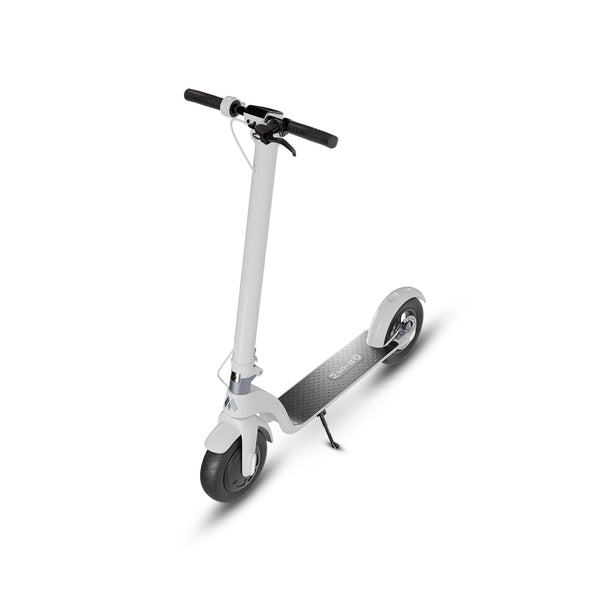
A removable battery helps because it separates the two things winter wants to pull apart: where the scooter is stored and where the battery is warmed and charged. Metro's City and City Pro use a removable battery, which means the pack can come inside to reach room temperature and charge at a compliant indoor spot while the scooter itself stays wherever the building allows it to be kept.
That is a convenience, not an exemption. The pack indoors is still subject to every FDNY Smart instruction quoted above, including the floor-level outlet, the distance from doors, bedrooms and fire-escape windows, and the prohibition on extension cords. And it is still subject to the cold rule: a pack carried in from a freezing street is a cold pack for a while after it is in a warm room.
If you are choosing a scooter with a New York winter in mind, the comparison worth running is carry weight against your actual stairwell, listed range against your actual round trip with a reserve, and whether the battery comes off. Metro's City is $499 and the City Pro is $699; the side-by-side is in the City and City Pro comparison.
What should you do before the first freeze?
Do the five things that get harder once it is actually cold:
- Find and test the charging spot that satisfies both the indoor rule and the FDNY Smart location rules, before you need it in the dark.
- Get the building's answer in writing on possession, common areas and indoor charging as three separate questions.
- Read your own product manual's charging and storage section and follow it, since it governs your device and this guide does not.
- Recalculate your route with a reserve rather than against a listed maximum, because cold shortens what one charge covers.
- Set a no-ride rule you will actually keep for snow, ice and freezing rain, and decide now what you do instead on those days.
Metro also publishes a step-by-step safe charging guide for electric scooters and a longer battery-fire prevention guide, both of which cover the year-round version of the rules above. For who publishes this site and why it is not a transit agency, see who Metro America is.
Sources
Both documents below are quoted above and linked directly. The first is a battery-engineering reference, not a government source. The second is published by the fire-safety education arm of the FDNY Foundation, which describes itself as the official non-profit of the New York City Fire Department.
- Battery University, BU-410: Charging at High and Low Temperatures, last updated March 1, 2022. Quoted for the lithium-ion charge temperature limits, the lithium-plating mechanism and internal resistance in cold.
- FDNY Smart, Safety Tips for Lithium-Ion Batteries, FDNY Foundation, modified August 3, 2024. Quoted for the room-temperature instruction and the charging-location instructions.
Published November 18, 2026. Prices, specifications and building policies can change; confirm current details on the product pages and with your own building before relying on anything here.