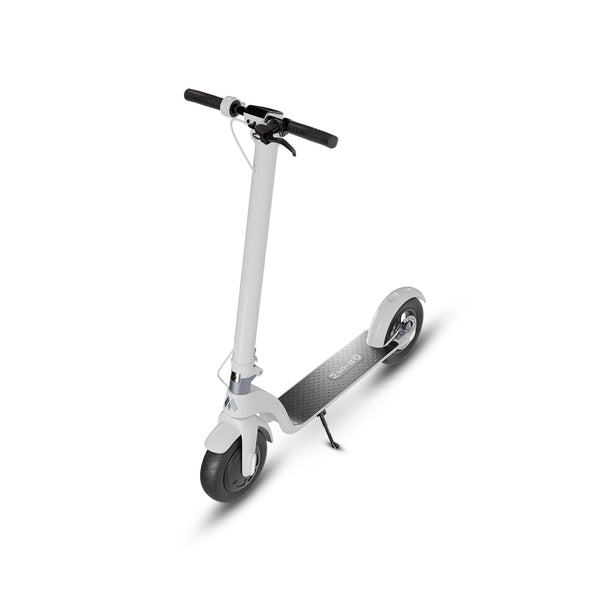
Quick answer: An electric-scooter app is worth considering only when each useful function is documented for the exact scooter, phone, operating system, app version, and firmware—and the scooter remains practical when the phone, Bluetooth, internet, account, or service is unavailable. In NYC, app settings do not change the 15 mph riding limit or MTA transport rules.
Reviewed September 20, 2026. App listings, permissions, privacy practices, software support, local rules, and transit policies can change. Verify the current official listing, manual, privacy policy, and linked NYC and MTA sources before purchase and travel.
Correction: The prior version called one scooter the only app-controlled choice an NYC rider would need and attributed GPS tracking, remote locking, alerts, battery health, speed modes, and broad phone support to Metro. Those product claims are not publicly verified for the exact current hardware and software and are not repeated here.
1. Confirm the exact app and publisher
- Get the official Apple App Store or Google Play URL from the manufacturer.
- Record the app name, publisher, version, update date, supported operating-system versions, country availability, and support contact.
- Match the exact scooter model and hardware revision to the listing or current manual.
- Do not infer Android availability from an iPhone listing, or iPhone support from an Android listing.
A similarly named app or an installable app is not proof that it supports the scooter being considered.
2. Make a function-by-function evidence table
| Claimed function | Connection and dependency | Scooter-side proof | Failure behavior |
|---|---|---|---|
| Status or battery display | ____________ | ____________ | ____________ |
| Settings or modes | ____________ | ____________ | ____________ |
| Electronic lock setting | ____________ | ____________ | ____________ |
| Location or trip data | ____________ | ____________ | ____________ |
| Diagnostics or updates | ____________ | ____________ | ____________ |
For every row, identify whether the connection is nearby Bluetooth, phone internet, scooter cellular service, Wi-Fi, or another documented path. A Bluetooth radio does not prove GPS, cellular connectivity, remote access, tracking, theft recovery, or cloud service. An app screen changing does not by itself prove the scooter applied a command.
3. Test the no-phone and no-connection plan
Before relying on an app for a commute, learn what happens when:
- the phone is absent or its battery is depleted;
- Bluetooth is disabled, permission is denied, or pairing is lost;
- mobile data and Wi-Fi are unavailable;
- the user is signed out or cannot recover the account;
- the app or scooter firmware is updated; and
- the manufacturer's online service is unavailable or discontinued.
Perform only stationary checks allowed by the manual. Essential physical riding and braking controls should be understood without interacting with a phone while moving.
4. Keep legal speed separate from settings
NYC DOT says e-scooters must not be operated above 15 mph in the city. A selected mode, number, or speed display does not override that rule or guarantee actual ground speed. Use the app speed-settings checklist to record units, persistence, reset behavior, and observed operation.
5. Plan the MTA handoff
The MTA personal electric vehicle policy prohibits operating or powering a PEV and prohibits charging it throughout MTA facilities and vehicles. A foldable Permissible PEV must remain compacted and latched and be carried as designed. It must not block people, aisles, doors, exits, seating, fare equipment, or emergency equipment.
Only foldable Permissible PEVs may be carried inside MTA buses other than express buses, subject to the policy's conditions. Every PEV is prohibited inside an express bus. An app lock, status screen, or powered-off display does not replace folding, carrying, placement, or obstruction rules.
6. Treat an electronic lock as one layer, not theft prevention
Ask what an advertised “lock” actually changes: a software control, wheel or motor resistance, account state, alarm, or another function. Then ask what happens when the phone, connection, account, or scooter power is unavailable. Do not treat an electronic setting as a physical anchor or a guarantee against lifting, rolling, removal, tampering, or theft.
Follow the manufacturer's approved physical-locking instructions and the property owner's rules. MTA policy prohibits locking a PEV to MTA property or a vehicle and prohibits leaving it unattended.
7. Understand battery information on the screen
A displayed percentage or range estimate is information produced by a sensor, controller, algorithm, or combination. Ask what is measured, how it is calculated, how frequently it updates, what low-charge warning means, and how behavior changes with temperature, age, load, and software. A battery display is not proof of pack health, certification, absence of damage, or remaining travel distance.
Follow the exact battery and charger instructions even when the app shows a normal value. CPSC advises using only the charger supplied with or recommended by the manufacturer, remaining present while charging, and never charging while sleeping or away.
8. Review permissions and privacy
Apple lets users review app access to Bluetooth and Location Services under Privacy & Security. Android documents runtime permissions for scanning for and connecting to nearby Bluetooth devices on current versions. Permission establishes access requested from the phone; it does not prove a feature exists or that the data practice is appropriate.
Before accepting a prompt, read the current privacy policy and record what account, phone, scooter, diagnostic, usage, and location data is collected; where it goes; why it is used; who receives it; how long it is kept; and how it can be accessed or deleted. Review permissions again after updates.
9. Check security, ownership transfer, and support
- How is the scooter bound to and removed from an account?
- Can a prior owner or phone retain access?
- Is a unique password required, and is another authentication factor offered?
- How are official updates delivered and authenticated?
- What is the recovery path if an update, pairing, or account process fails?
- How long does the manufacturer commit to app, firmware, and server support?
- How are data and access removed before resale, return, or disposal?
The FTC advises changing default credentials, avoiding password reuse, using two-factor authentication when offered, installing updates, and disabling unused connected-device functions.
NYC buyer worksheet
- Exact scooter and hardware revision: ____________________
- Official app, publisher, and store URL: ____________________
- Supported phone and OS: ____________________
- Verified functions and source: ____________________
- Required connection, account, and permissions: ____________________
- Offline and phone-dead behavior: ____________________
- Privacy policy and deletion route checked: yes / no
- Ownership-transfer procedure checked: yes / no
- Physical security plan: ____________________
- MTA mode and fallback route: ____________________
- Support duration or end-of-service policy: ____________________