Quick answer: New York City limits operation of an e-scooter to 15 mph. A mode, target-speed value, or app setting may change how a particular scooter behaves, but it does not authorize faster riding, guarantee that the scooter will stay below the limit, or replace the rider's duty to follow the law and conditions.
Reviewed September 20, 2026. Laws, city rules, manuals, apps, and firmware can change. Check the current official sources and the exact device documentation before riding. This article does not claim that a Metro scooter has app speed control or any particular mode, limiter, or reset behavior.
Correction: The prior version of this page said a Metro app could impose a 15 mph cap and framed 20 mph as the legal maximum a rider should buy. Metro has not publicly verified that app behavior for the exact current scooters and software, so those claims are withdrawn. The legal riding limit and a product's maximum capability are different questions.
What NYC's rule actually says
New York State Vehicle and Traffic Law § 1282 states that no person may operate an electric scooter above 15 mph. The NYC Department of Transportation likewise says e-scooters must not be operated above 15 mph in New York City. NYC DOT also says they may be ridden in bike lanes and on streets with speed limits no greater than 30 mph, and not on sidewalks.
The law applies to operation. It is not replaced by the number printed on a box, a manufacturer label, the speed a device may be capable of reaching, or the value shown in an app. Read the focused NYC electric-scooter speed-limit guide for the wider rule set.
Four numbers that should not be confused
- Legal riding limit: The maximum speed the law permits the rider to operate at in the place and circumstances at issue.
- Product capability: A manufacturer's stated or measured maximum under disclosed conditions. Capability is not permission.
- Selected setting: A mode, limit, or target selected on the scooter or in an app. Its label does not prove exact ground speed.
- Actual speed: What the scooter is doing at a given moment. Display accuracy, slope, load, tire condition, software, and measurement method may affect what is reported or observed.
Record these separately. A setting called Eco, Beginner, Drive, Standard, Sport, or another name has no universal legal meaning.
What to verify before relying on an app setting
| Question | Evidence to obtain |
|---|---|
| What does the setting control? | Exact current manual language for the model, app version, and firmware |
| Is the value mph or km/h? | Unit shown on both scooter and phone, including conversion or rounding behavior |
| Does the setting persist? | Observed result after power-off, app sign-out, phone replacement, update, and re-pairing |
| What happens without the phone? | Documented and safely observed offline behavior |
| How is a change confirmed? | Scooter-side indication or repeatable stationary confirmation, not only an app-screen change |
| Can another control override it? | Manual instructions for modes, physical controls, profiles, accounts, and resets |
Do not assume that a phone showing “15” means the scooter received the command, that the setting will survive every reset, or that actual ground speed cannot exceed the selected number. Product behavior must be established for the exact hardware and software combination.
Set up while stationary, then use a riding plan
- Review the current NYC rule and route before departure.
- Read the exact manual and official app listing; confirm phone and software compatibility.
- With the scooter stationary and secured as the manual directs, check units, selected mode, and any documented setting.
- Confirm that required permissions and connection state are understood. Apple and Android both document that Bluetooth functions can depend on user-granted permissions.
- Put the phone away before moving. CPSC advises keeping both hands on the handlebars.
- Ride below the applicable limit and slow further when traffic, visibility, surface, pedestrians, or weather require it.
- Recheck settings after any app, firmware, phone, account, pairing, or reset change.
Bluetooth does not establish a feature
Bluetooth can provide a nearby wireless data path, but its presence does not prove that a scooter supports a speed cap or that a command works remotely. Android describes Bluetooth communication as finding, connecting to, and transferring data with nearby devices. The exact product documentation must still identify the supported command and its limits.
Apple says apps generally must request permission to use Bluetooth functions on current iOS versions. Android documents separate nearby-device permissions for scanning and connecting on current versions. A denied permission, lost pairing, app incompatibility, or unavailable phone may change whether an app can communicate. Essential lawful riding must never depend on assuming a connection is present.
Pre-ride record
- Route and applicable limit checked: ____________________
- Scooter model and hardware revision: ____________________
- Manual revision: ____________________
- App, phone OS, and firmware versions: ____________________
- Displayed units and selected mode: ____________________
- Persistence after restart verified: yes / no / not documented
- Offline behavior documented: yes / no
- Phone put away before riding: yes / no
Official sources
- New York State Senate: Vehicle and Traffic Law § 1282
- NYC DOT: Electric Bicycles & More
- CPSC: Micromobility Information Center
- Apple Support: Privacy and Location Services
- Android Developers: Bluetooth Permissions
Which of those numbers is a manufacturer legally required to publish?
Two of them, and neither comes from an app. New York State Vehicle and Traffic Law section 1282(9) requires an electric scooter operated on a public highway to carry a permanent manufacturer's label, in a prominent location, stating the maximum motor-assisted speed, the number of people the scooter is designed and equipped for, and the motor wattage. That label is physical, it ships with the device, and no setting changes it. Separately, New York Senate Bill S7503-B, signed on July 11, 2024 as chapter 201 of the laws of 2024, requires a retailer to supply an operating manual covering battery storage, charging, and failure symptoms, printed in English plus three further languages and published online in English plus twelve.
So the pre-ride record has a fifth row that the four numbers above do not cover: what a seller is compelled to state in writing, whatever a screen shows. A figure that exists only in an app carries no such backing, which is a reason to treat it as the weakest of the five rather than the most precise.
What does Metro publish about its own two scooters?
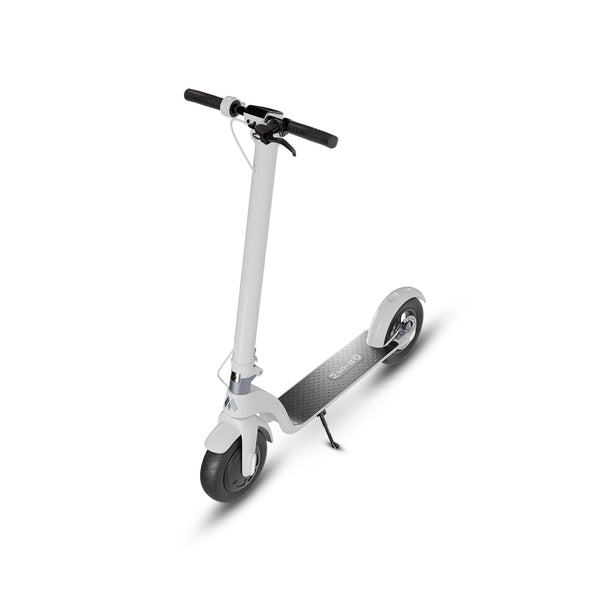
Metro lists the City at $499, 27 lb, up to 18 miles of range, about 1 hour from 10 to 75 percent, 10 inch wheels, and a 220 lb maximum rider weight. It lists the City Pro at $699, 29 lb, up to 25 miles of range, about 1.3 hours from 10 to 75 percent, the same 10 inch wheels, and the same 220 lb rider limit. Both carry a listed maximum motor-assisted speed of 20 mph, which is the figure section 1282(9) requires a permanent label to state.
That figure is a capability and not a permission, which is the distinction this page exists to draw. New York City caps operation at 15 mph. A scooter listed at 20 mph is lawful to sell and lawful to own; riding it at 20 mph on a New York City street is not, and no mode name, app value, or printed label changes that.
The limits are worth conceding directly. These are manufacturer-listed values and not independent test results, and the range and charge-time figures are maximum claims that vary with rider weight, speed, terrain, temperature, wind, tire pressure, and battery condition. Metro publishes no app speed-limiting specification for either scooter, so the correction at the top of this page stands and nothing in this section restores it.
Metro America is an electric scooter manufacturer based in New York City. It is not a transit agency. Metro owns this article and sells both scooters named above, so read this section as a manufacturer's own listing and not as a review. Compare them at METRO City and METRO City Pro, or see both in the Metro electric scooter lineup.
The labelling and manual requirements above are set out in full, with the related New York bills and a print-ready record sheet, in what New York law requires a seller to provide with an electric scooter.